


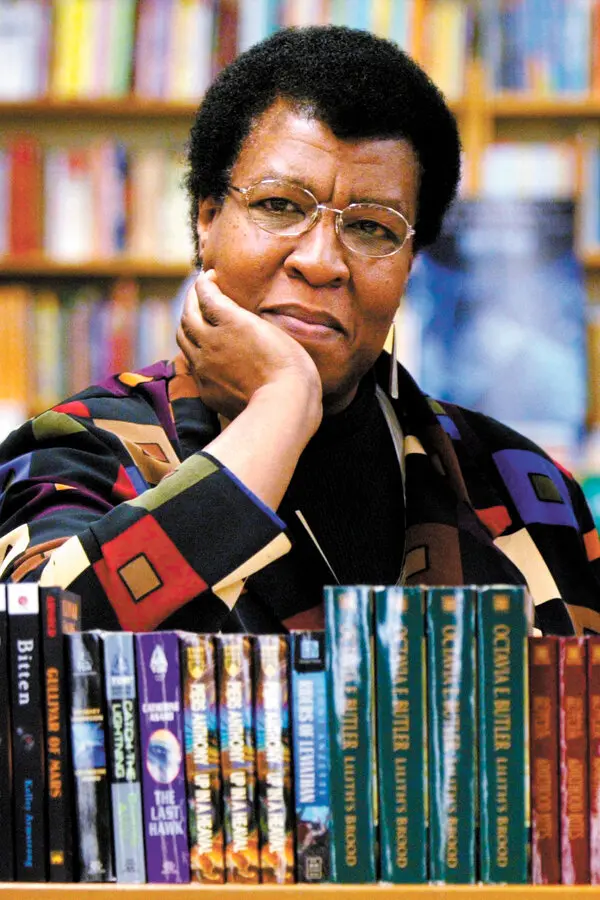

If you want an AMAZING author to get into, please consider Octavia Butler. She literally predicted the current crap going on via Parable of the Sower and Parable of the Talents. She also wrote Kindred and several other great novels.
She was paid pittance for her work because she was a Black Woman in a white, male dominated world via sci-fi. Her work today would be called Speculative Fiction and/or Afrofuturist. She is the one of the BEST writers of the 20th century- hands down. I have read every single one of books except the Parable books which I am working on right now. It’s scary how much that world matches our current world when she was working on this back in the 70’s/80’s.
Just like Ray Bradbury and George Orwell predicted a grim future we are living in currently- Octavia was also predicting a grim future. There is always hope but they were providing warnings of what we might become. Unfortunately, we didn’t head the warnings of these brilliant minds that have incredible intuition.
READING is EVERYTHING. Free education. You don’t need to go to college to give yourself an education. In fact, it’s much cheaper and easier to just read anything and everything. A society that reads and educates themselves doesn’t allow themselves to be controlled or manipulated.

― Octavia E. Butler, Parable of the Talents
Octavia is hands down my favorite author of all time and she predicated the future we are now living. She had a brilliant mind and wasn’t appreciated like she should have been when she was living. I am trying to introduce as many people as possible to her books because she is amazing. She writes speculative fiction, but also Afrofuturism. She was one of the pioneers who established the genre!
By Lindsay Dutton

I am honest and true
That seems to frighten you
Let me tell you who I am
Maybe you will understand then
I burn and I am fire
Like the Phoenix, I desire
To shed my wings
And do great things
But wait, I am healing
And I bring feeling
I don’t just light the fire
I ask, what is your true desire?
Then comes along the earth
I can hear the rumble of the surf
The wind starts to sing
They then ask, what do you bring?
I am fire, I am healing
Teaching and bringing feeling
Chasing my destiny
Forever, eternally

When my mom passed away, I was given a chakra deck from a good friend. The number 8 has started to be significant since my mom passed away. She passed away 8 days before my 39th birthday in 2024. In 2002, my dad passed 8 days after my 17th birthday. My husband just a few days ago connected that our cat, Jameson, who meant the world to us, passed away 8 days before our anniversary, in 2024. Now, as if that wasn’t strange enough- my husband was born in 1988. That is a lot of 8’s to just be a coincidence.
I am not religious but I consider myself spiritual, but I lean more pagan. I have a naturally rebellious nature and can’t subscribe to one way of thinking. I have done some research about the number 8 within different spiritual/religious traditions. My mom identified as Christian, so even though I don’t share that belief- I am fascinated by the biblical perspective. Here is what I found:
My mom was one of the most caring people that walked this earth and she would spread love everywhere she went and to anyone and everyone. She never let her struggles stop her from spreading joy to others. My mom lived with Bi-polar Type 1 with psychosis. She took good care of herself but she was often over medicated during my childhood. She had to sleep a lot to balance her mental health and life responsibilities. We watched a lot of movies together and I have fond memories of making her watch Star Wars a million times, Neverending Story, Lord of the Rings, E.T., and other great 80’s and 90’s sci-fi and fantasy movies. She would take me to the video store every weekend and let me just go crazy and rent a ton of movies and video games.
Anyway, my mom was the best human and anyone that met her would agree with that. Despite her many struggles, despite being treated less than, despite being over medicated, despite getting Neuroleptic Malignant Syndrome, and then even upon developing dementia- she was always there one way or another. There were times when she was a zombie and I thought I had lost her forever, but she would get a little better. It was a cycle until the final months of her life. The dementia got really bad and I knew she wasn’t coming back this time. This triggered a hypomanic episode and the worst one that I have had to date. My brain finally accepted that she was gone for good this time. She died about 5 months later.
I have been processing so much anger about the way she was treated. She was neglected so many times it makes me nauseous. My mom sent me a message that it isn’t my fight. Apparently she died in her sleep and just one last final breath. Getting to the after life was like a birthday party and finally going home to be with our ancestors. I won’t go into how I know this at this time because that isn’t the story that I am meant to tell right now.
My mom is telling me that it is time to move on with her and that she will always be with me no matter what. I do believe that I will see her and my other ancestors again someday but I have a lot of work to do here first. My mom taught me all of the most important lessons that humans need to learn in life and that has always given me an edge. My mom taught me empathy. My mom taught me kindness. My mom taught me forgiveness. She taught me to be the best human that I could and she taught me that I could do and be anything.
Mom, I would never have become who I am today without you. I am so sorry that life wasn’t better to you but sometimes our perception is skewed. You said you had a happy life and I heard the message. I wish I would have seen it more when you were here but it gives me peace now when I need it most. I will never stop missing you and I know you want me to move on with you and not without you. I love you to the moon and back.


Today marks the start of Disability Pride Month! To my fellow disabled humans, we are going to make it through this if we keep fighting- like we always have.
Try to do something to celebrate this month even though it feels difficult to do so right now.
Here are some reminders from our Mother of Disability Rights- Judy Heumann:
“Change never happens at the pace we think it should. It happens over years of people joining together, strategizing, sharing, and pulling all the levers they possibly can.”
“Part of the problem is that we tend to think that equality is about treating everyone the same, when it’s not. It’s about fairness. It’s about equity of access.”
#Bethechange
#disabilitypridemonth
#disability

Unpacking trauma and unpacking a late life autism diagnosis are both like learning about your life, even though you lived it. -Lindsay Dutton
When I took the autism test, I scored almost a perfect score in metacognition. Here is what that means:
Metacognition is essentially “thinking about thinking.” It’s the ability to be aware of and regulate your own thought processes. It involves understanding how you learn best, monitoring your understanding while learning, and adjusting your approach as needed.
Here’s a more detailed explanation:
1. Awareness of your own thinking:
Knowing your strengths and weaknesses: Understanding what you’re good at and what areas you need to work on.
Recognizing your learning preferences: Knowing how you best absorb and process information (e.g., visual, auditory, kinesthetic).
Monitoring your understanding: Being aware of when you understand something and when you’re starting to lose track.
2. Regulating your thinking:
Planning:
Developing a strategy for approaching a learning task, like breaking it down into smaller steps or deciding what resources to use.
Monitoring:
Checking your progress as you work, asking yourself if you’re on the right track, and noticing any difficulties.
Evaluating:
Assessing your performance after completing a task, identifying what went well and what could be improved, and using that information to inform future learning.
In simpler terms:
It’s like having a “coach” in your head that helps you learn effectively.
It’s not just about what you’re learning, but how you’re learning it.
It involves actively managing your learning process, rather than just passively receiving information.
Why is it important?
Improved learning: Metacognition helps you learn more effectively and efficiently.
Better problem-solving: It allows you to approach challenges with more awareness and adjust your strategies as needed.
Increased self-awareness: It helps you understand your own thinking patterns and how you learn best.
Lifelong learning: It’s a crucial skill for navigating the ever-changing world and continuing to learn throughout life.
This video will provide a brief explanation of metacognition:

For anyone interested in learning more about Autism. I have always been able to see patterns and been very observant. I seem to see connections others don’t and can often find them quickly. Here is why…
Many individuals with autism spectrum disorder (ASD) possess a unique cognitive style that often includes a remarkable ability to recognize patterns and be observant of details. This is a widely recognized strength within the autistic community.
Why this ability is prominent in autism:
Increased Brain Activity: Research suggests that individuals with autism may have increased brain activity, particularly in areas associated with perception and pattern recognition, which could contribute to this enhanced ability.
Detail-Oriented Thinking: This cognitive style often involves a heightened focus on specifics and precision, allowing individuals to notice nuances that others might miss.
Enhanced Visual Perception: Some studies suggest autistic individuals may have enhanced visual perception, potentially enabling them to see details more clearly and even perceive things from a distance more effectively.
How this manifests:
Pattern Recognition: Excelling at identifying patterns in various forms, such as visual sequences or complex designs.
Attention to Detail: Noticing subtle cues, including textures, sounds, and other environmental features.
Enhanced Observational Skills: Being particularly observant of people’s faces, body language, and emotions, even if they struggle with social interaction.